|
E-Mail not displaying correctly? Click here for online version
|
|
|
|||


|
|
Purifying proteins easily using ion exchange chromatography (IEC)
|
|
Dear Reader,
|
|
Basics
The IEC method Since proteins have a specific charge density distribution due to the zwitterionic nature of their building blocks and their individual structure, they can interact in a differentiated manner with a charged stationary phase.
Ion exchange chromatography separates molecules based on their net charge. The stationary phase, an ion exchanger, is selected according to the charge characteristics of the target proteins. For molecules with a positive total charge, a cation exchanger (see Fig. 1) is used. The stationary phase itself is of the opposite charge (negative in this case). |
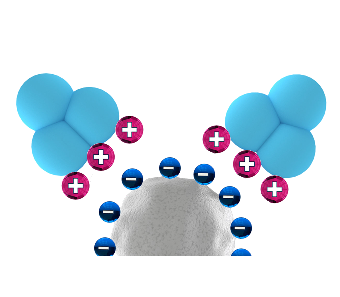
Figure 1: Cation exchanger (stationary phase, grey) with symbolized protein molecules (light blue) |
| |||
|
Application
|
|
|
Separation of model proteins by IEC
|
|
|
|
|
|
|
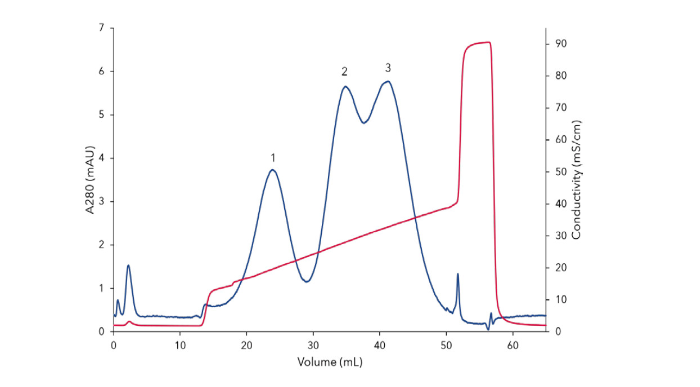
The three substances α-chymotrypsinogen A, cytochrome C and lysozyme are eluted from the cation exchange phase by means of a salt gradient. The blue trace shows the elution profile (chromatogram) measured on the basis of the UV signal at a wavelength of 280 nm. The red trace shows the conductivity signal. The linear increase in conductivity due to the programmed salt gradient can be clearly seen.
This application was made, using an AZURA® Bio Lab Purification system with a cation exchanger column.
|
|
|
FPLC all-rounder
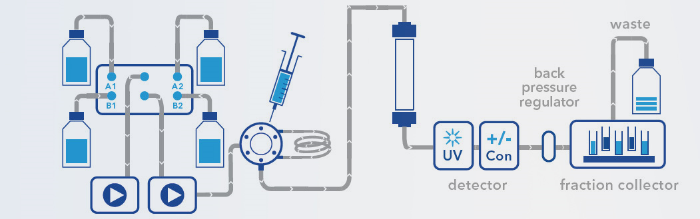
The AZURA® Bio Lab Purification system for FPLC methods such as IEC features a high-precision binary gradient pump for flow rates up to 50 ml/min with two selectable buffers per channel.
The system with its metal-free flow path meets demanding FPLC requirements and is suitable for Affinity (AC), Hydrophobic Interaction (HIC), Ion Exchange (IEC), and Size Exclusion Chromatography (SEC).
The AZURA® Bio Lab system is available at a special price for a limited time. Contact us. Inquiries to sales@knauer.net or
|
AZURA® Bio Lab system 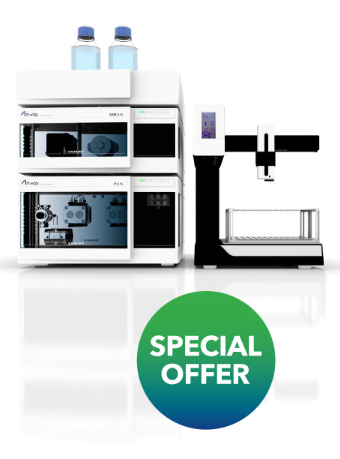
*Technical data are subject to change without notice. Prices may vary by country and do not include taxes, customs duties or delivery. |
|
Training / Workshop
|
||
|
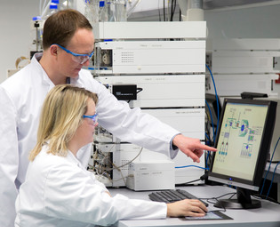
FPLC training Nov. 14, 2018 | 09:00 - 17:00In theoretical as well as practical parts of this course users will learn the basics of FPLC and will also get useful tips for a successful purification of biomolecules. Target audience: Users who want to purify proteins using FPLC. The course is suitable for beginners and for users with basic knowledge. This course date is planned for users who speak German, but we can also offer it in English on request. For questions and registration, please contact us via academy@knauer.net
|
|

|
Oliver Gültzow
Do you have comments? Feel free to contact me via the e-mail address below. On behalf of the KNAUER team I wish you a nice day! |
||
|
|
|
||||||||


